Heart rate variability on your wearable: what the number means
HRV is the change in time between heartbeats. Here is how Oura, Whoop, Garmin, Fitbit and Apple Watch measure it, why their numbers can't be compared, how accurate they are, and how to read your own trend.
- Read
- 5 min
- Length
- 1044 words
- Published
- By
- Data2Fit
Heart rate variability (HRV) is how much the time between your heartbeats changes from one beat to the next, measured in milliseconds. A higher number than your own usual usually means your body is well rested; a drop below your usual often follows hard training, alcohol, a short night or the start of an illness. The number on your watch or ring is only useful against your own baseline, and you can't compare it with a friend's on another brand, because the brands don't all calculate the same thing.
What HRV actually measures
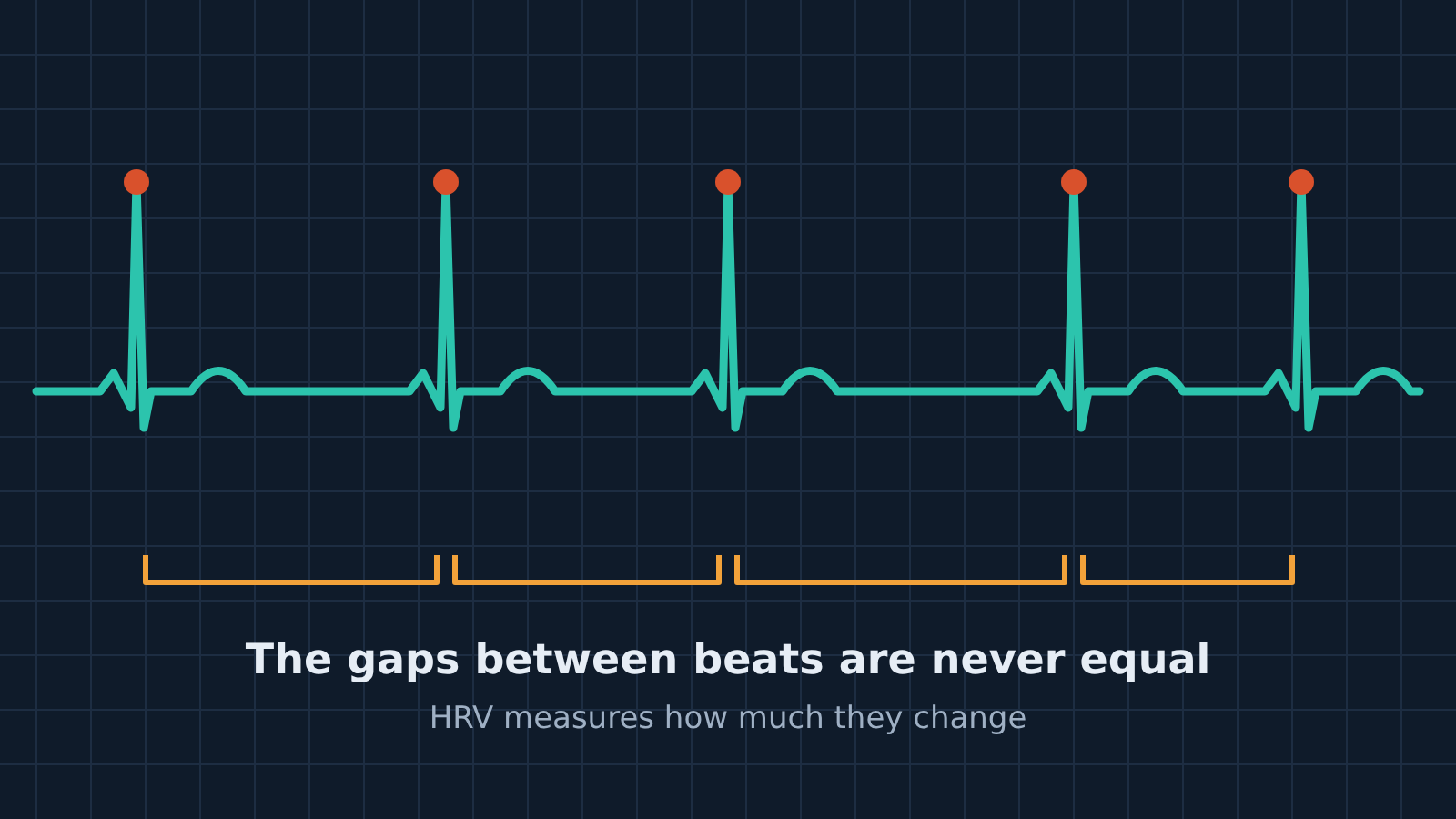
Your heart doesn't tick like a metronome. At 60 beats per minute the average gap is one second, but individual gaps might run a little shorter, then a little longer, then shorter again. That beat-to-beat wobble is HRV.
Much of the short-term wobble comes from the parasympathetic ("rest and digest") branch of the nervous system, which can slow the heart within a single beat. When you're relaxed and recovered, that branch is active and the gaps vary more. When you're stressed, ill or fatigued, the gaps tend to become more even, and HRV falls.
How your wearable estimates it
Watches and rings don't record an ECG for HRV. They use photoplethysmography (PPG): green or infrared LEDs shine into the skin and a sensor reads how much light comes back as each pulse of blood passes. The device finds each pulse, times the gap to the next one, and runs a formula over a window of those gaps.
Movement ruins those timings, which is why most devices measure HRV while you sleep:
- Oura measures HRV only during sleep, in five-minute samples through the night, and shows the average of those samples, according to Oura's support pages.
- Whoop staff have described calculating HRV in overlapping five-minute windows across the whole night, removing wake periods and giving more weight to likely deep sleep and to later in the night.
- Fitbit reports nightly HRV from sleep periods longer than three hours, according to its developer documentation.
- Garmin's HRV Status uses overnight readings and compares your recent seven-day average against a personal baseline range. Garmin says it needs about three weeks of wear to set that baseline.
- Apple Watch takes HRV readings in the background and stores them in Apple Health.
The formula matters: RMSSD vs SDNN
Two formulas cover nearly every wearable.
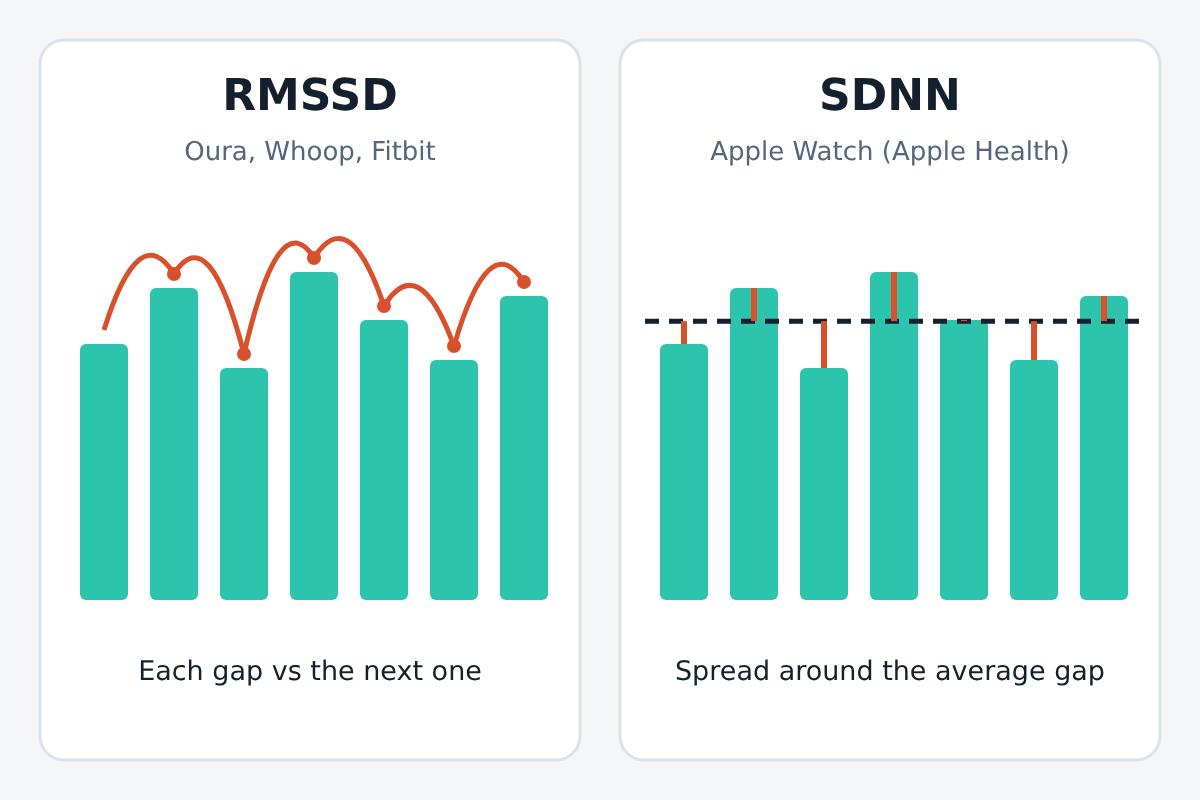
RMSSD (root mean square of successive differences) looks at how much each gap differs from the one right after it. Because it tracks fast beat-to-beat changes, it is the measure most closely tied to parasympathetic activity. Oura, Whoop and Fitbit all report RMSSD. Garmin doesn't name its formula on its consumer pages.
SDNN (standard deviation of normal-to-normal intervals) measures how widely all the gaps in a window spread around their average. It picks up slower swings as well as beat-to-beat ones. Apple Health records HRV as SDNN.
So an Apple Watch reading of 45 ms and an Oura reading of 45 ms don't describe the same thing, and neither does the same formula over a different window (a five-minute nap check versus a whole night's average). If you move between brands, start a new baseline instead of carrying the old numbers over.
How accurate wearable HRV is
Overnight HRV from a good-fitting device can track an ECG closely. The most direct comparison so far is a 2025 study by Dial and colleagues in Physiological Reports. Thirteen healthy adults slept with an ECG and several wearables at once, for 536 nights in total. Oura Gen 4 (concordance 0.99) and Oura Gen 3 (0.97) agreed most closely with the ECG for overnight HRV, Whoop 4.0 agreed moderately (0.94), and the Garmin Fenix 6 agreed poorly. Keep the limits in mind: it was a small group of healthy adults, Oura promotes the result on its own website, and Whoop's researchers replied in the same journal that devices have to be compared over matching measurement windows to be fair.
Daytime spot readings are noisier than overnight ones, because a small movement or a loose strap shifts the pulse timing. That is the main reason to judge your HRV from nightly values, not from a reading taken while you're walking around.
What moves your HRV
Your HRV will swing from night to night, and some of the reasons are well known:
- Alcohol in the evening tends to lower that night's HRV and raise your heart rate.
- Hard or unusual training can push HRV down for a day or two while you recover.
- Illness often shows up as a drop in HRV, sometimes alongside a rising resting heart rate, before you feel properly unwell.
- Short or broken sleep, late heavy meals, heat and stress tend to lower it.
- Age matters across years: HRV tends to decline as people get older, which is one more reason not to compare yourself with others.
Regular aerobic training and consistent sleep are the habits most often linked with a higher HRV over months. Expect gradual change in the trend line, not a jump in a week.
How to read your number
Look at the trend, not the single night. Oura advises reading HRV against your own history, and Garmin builds its status entirely around your personal range, for the same reason: healthy adults vary widely, and a "low" number for one person is normal for another.
A practical routine:
- Wear the device every night for at least two to three weeks before drawing conclusions.
- Watch the weekly average. One low night after a late dinner means little; a week below your usual range is worth a look at your sleep, training and stress.
- Change one thing at a time (an earlier last drink, a lighter training week) and see whether the trend responds.
When to see a doctor
HRV from a consumer wearable is a wellness signal, not a diagnosis. Don't use it to rule anything in or out. See a doctor if your watch shows irregular rhythm notifications, or if you have chest pain, fainting, a racing or pounding heart at rest, or unusual shortness of breath, whatever your HRV says.
