VO2 max on your watch: how it is estimated and how far to trust it
Your watch estimates VO2 max from your heart rate at a known speed. Here is how Garmin, Apple and Fitbit do it, how close they get to a lab test, and what makes the number jump around.
- Read
- 5 min
- Published
- By
- Data2Fit
VO2 max is the most oxygen your body can take in and use per minute during all-out exercise, given in millilitres per kilogram of body weight per minute (mL/kg/min). Your watch doesn't measure it. It estimates it from how hard your heart works at a given running or walking speed, and that estimate is good enough to follow your own trend but not to settle a bet with a friend who wears a different brand.
What VO2 max measures
During hard exercise your muscles need oxygen, and VO2 max is the ceiling: how much your heart, lungs, blood and muscles together can deliver and use. It's the classic measure of aerobic fitness, which is why sports scientists have used it for decades.
In a lab, it's measured directly. You run on a treadmill or ride a bike while wearing a mask that analyses the air you breathe in and out, and the effort climbs in stages until you can't keep going. The highest oxygen uptake you reach is your VO2 max. That test is accurate, but it's hard work and needs equipment few people have access to, which is why wearables try to get close without it.
Because the number is per kilogram, it also moves when your weight changes, even if your heart and lungs haven't.
How your watch estimates it
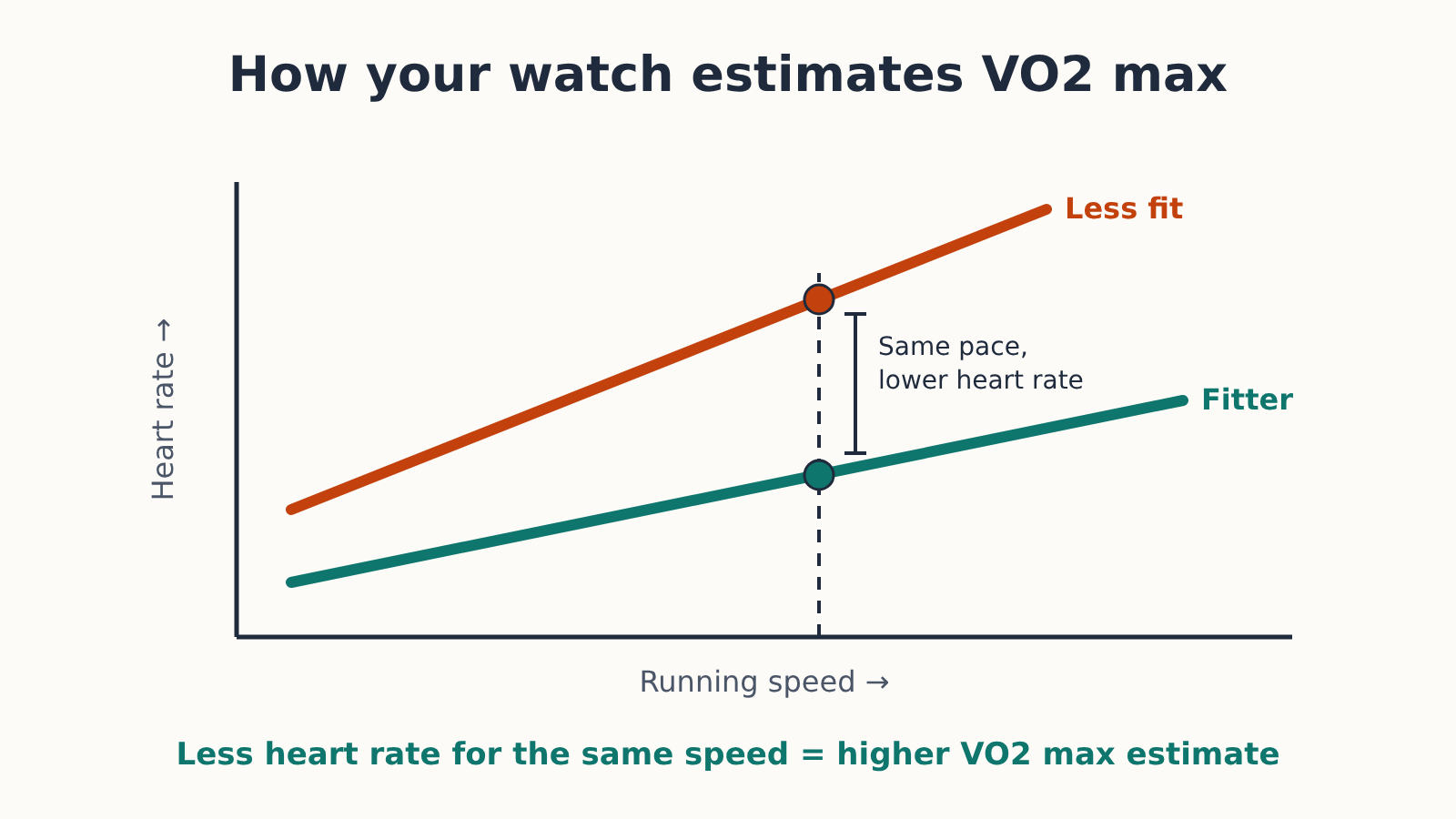
The idea behind most watch estimates is simple. A fitter person needs fewer heartbeats to run at a given speed, because each beat pumps more blood and the muscles use the oxygen better. So if the watch knows your heart rate and your speed at the same moment, and roughly where your maximum heart rate sits, it can work out where your ceiling probably is.
The brands handle the details differently:
- Garmin uses analytics licensed from Firstbeat. Running estimates come from outdoor runs, combining wrist or strap heart rate with GPS speed; cycling estimates need a power meter. Garmin's fitness categories by age and sex come from data published by The Cooper Institute.
- Apple Watch calls it Cardio Fitness. It's estimated during outdoor walks, runs and hikes from heart rate and movement, and the Health app sorts it into levels from Low to High for your age and sex.
- Fitbit shows a Cardio Fitness Score. Without a run it leans on your resting heart rate and profile details such as age, sex and weight; Fitbit says outdoor runs with GPS give it a better estimate.
All of these depend on two inputs being right: your heart rate during the activity and your speed or power. If either is off, the estimate drifts.
How accurate it is
A 2022 systematic review and meta-analysis in Sports Medicine (Molina-Garcia and colleagues) pooled studies that compared consumer wearables with lab tests. Estimates based on exercise data were clearly closer to the lab value than estimates based on resting data alone. That matches the logic above: a heart rate at a known running speed carries much more information than a resting pulse.
Even the better estimates can miss an individual's lab result by a meaningful margin, and the review's authors were cautious about using them as a substitute for a lab test. So read your watch's number as a ballpark, and read the changes in it as the useful part.
Most of the error comes from what the watch is fed:
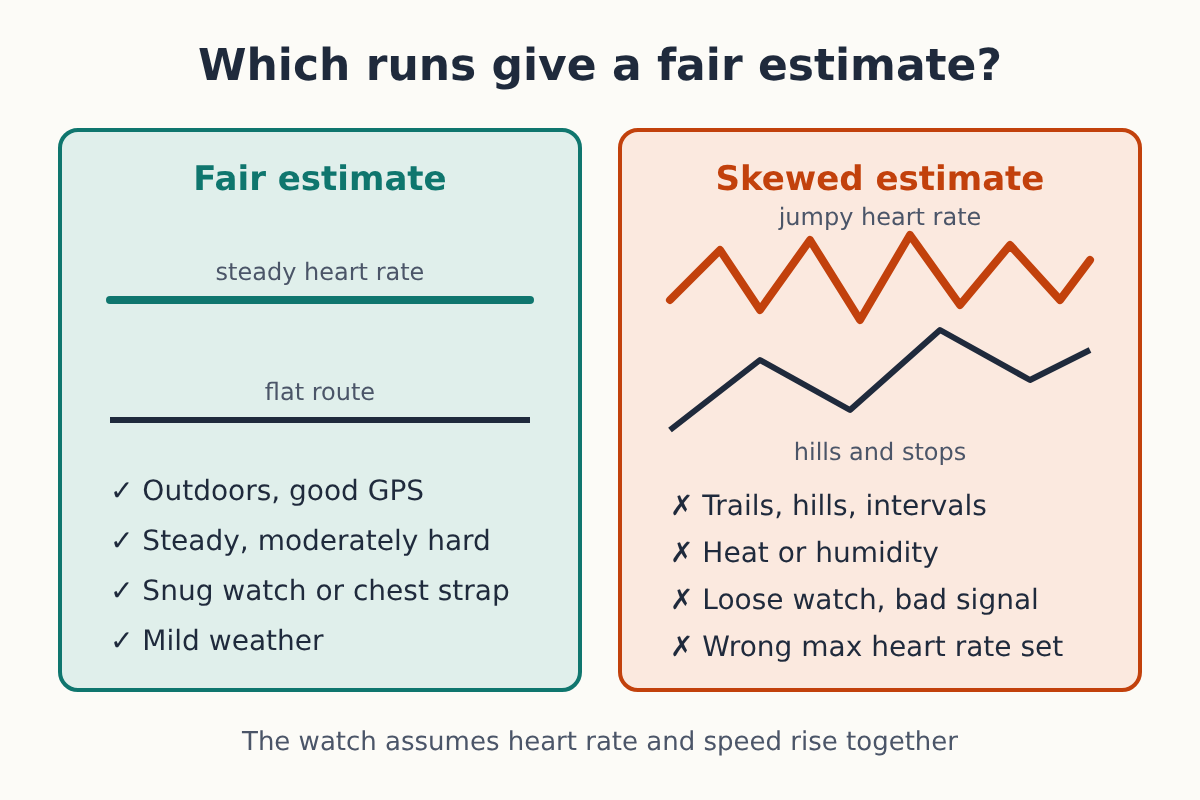
- Heart rate signal. Optical sensors can lag or lock onto your cadence at higher effort. A loose band makes this worse; our guide to when a wrist sensor falls behind a chest strap explains what to look for.
- Maximum heart rate. If the watch uses an age formula and your real maximum is quite different, the estimate shifts with it. Setting a measured maximum, as described in setting heart rate zones that match your body, helps both.
- Terrain and speed. Hills raise your heart rate without raising your speed, and stop-start running muddles the pairing. GPS errors under trees or between tall buildings do the same.
- Heat, humidity and altitude. All of them push heart rate up at the same pace, so the estimate can dip in a summer heatwave or on a mountain trip even though your fitness hasn't changed.
- Medicines. Apple notes that medicines which limit heart rate, such as beta blockers, can make Cardio Fitness less reliable, and the Health app lets you record them.
What moves your VO2 max
The real number changes slowly. Weeks to months of regular aerobic training raise it, and both steady endurance work and harder intervals have been shown to improve it in research. Stopping training lowers it, and it tends to decline with age. Losing or gaining weight changes the per-kilogram figure.
The watch's number can change faster than that, and those fast changes are mostly noise. A drop of a point or two after a hot, hilly week is the conditions, not lost fitness. A steady rise over two or three months of consistent running is far more likely to be real.
Why it's worth tracking
Cardiorespiratory fitness is one of the stronger markers of long-term health. A 2009 meta-analysis in JAMA (Kodama and colleagues) found that each 1-MET increase in fitness, about 3.5 mL/kg/min of VO2 max, was associated with around a 13% lower risk of death from any cause. That's an association across large groups, not a promise for one person, but it's a good reason to care about the trend.
How to use it
- Give it clean data. Do a steady outdoor run or brisk walk on a flat route with good GPS every week or so, with the watch snug or a chest strap paired.
- Check your settings. Make sure your age, weight and maximum heart rate are current.
- Track the trend, not the day. Compare month to month. If you also follow resting heart rate and heart rate variability, a rising VO2 max alongside a slowly falling resting heart rate is a consistent sign your aerobic fitness is improving.
- Compare with yourself. Different brands use different methods, so don't switch devices and expect the number to carry over.
When to see a doctor
A low or falling VO2 max estimate is not a diagnosis. If your fitness drops sharply without an obvious reason, or you notice breathlessness, chest pain, dizziness, fainting or an unusually fast or irregular heartbeat during exercise, stop and get medical advice rather than waiting for the watch to update.
